

AI Promised Efficiency. Here’s Where It Went.
Billions spent, no movement on the P&L. A factory floor explains why.

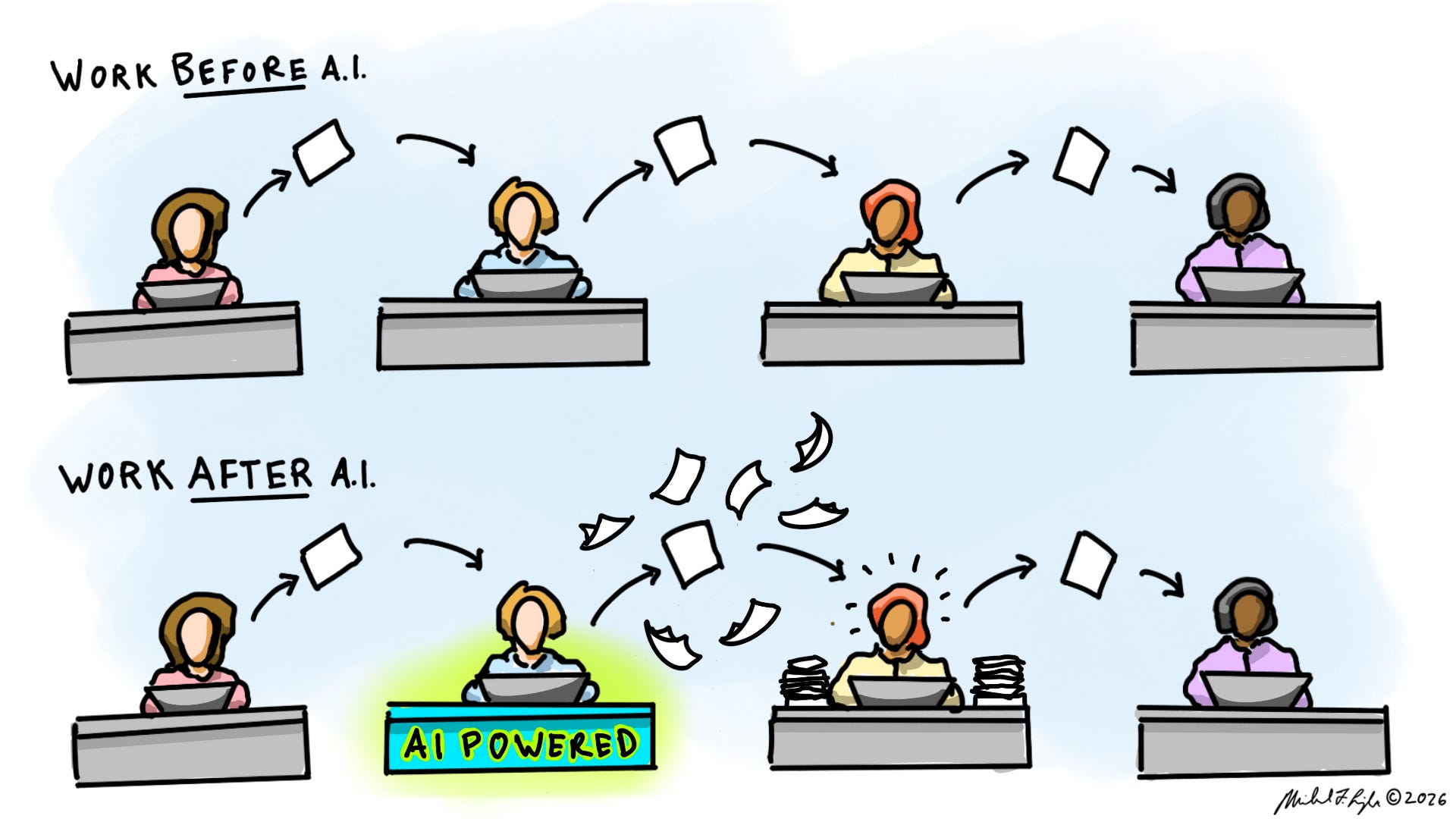
If you’re still waiting for the flood of value to pour in from your organization’s AI initiatives, you’re not alone. Last summer MIT published research finding that 95% of enterprise AI pilots show no measurable return — billions spent, no real movement on the P&L. But if you’re like me and you use these tools personally and at work, you know the value is somewhere; we just can’t put our finger on it. So is it over-hyped, or are we looking in the wrong place? From where I sit, straddling the enterprise and a manufacturing floor that builds a car a minute, I can tell you it’s the second one. Here’s where it actually went.
Start with what work looked like before AI. Imagine a worker with a full year of work planned out quarterly, chipping away at it incrementally. Their pace is mostly even and predictable.
Now hand that same worker AI tools — Microsoft Copilot, maybe a few agents built into their corporate platforms — and they’re bought in. They’re not only doing more work, they’re pulling work ahead from future quarters. Supercharged.
But notice the gains aren’t really showing up yet, aside from reports and slide decks looking a little more polished. It seems like more work is getting done — and it is. The work never stops, and most folks have more on their plate now than ever. So where’s the promised value?
Here’s the first place it went. I’ve heard it said that with hiring frozen, we should be able to do more if we’d just adopt the tools. For a while I believed it too. But even doing more, a workforce will never keep pace with retirements, attrition, and roles left unfilled while we wait out the economy. What you’re really asking people to absorb is their own workload, plusthe new work AI makes possible, plus the work of the people who were never hired — and on top of all of it, the cognitive load of becoming a sharp prompt engineer to get good output. Remember, the work never stops.
Any workforce planning built on AI’s impact without clear, visible, KPI-level efficiency gains is just using AI as cover for other motives.
The second place it went takes more looking. You have to look at the work itself — what the worker is actually doing, and which of those steps create value for the end customer. Even knowledge work has to be seen the way a manufacturing line is seen: a flow of processes, each handing off to the next in a value stream. The best way to see it is to map every step.
Because that worker sits inside a larger organization, where value flows from one group to the next, one process to the next. Whether you’ve visualized it or not, that value stream is already running. And when one person with AI starts doing more and pulling work ahead, but the processes downstream haven’t adapted to the new demand — you’ve just created a bottleneck.
If this is starting to sound like the Toyota Production System, you’re right. When I walk the floor, I see a continuous flow of processes, systems, and equipment producing a new car every minute. If one process has an issue, the whole flow stops. If one process speeds up, it overproduces, pressures everything downstream, and creates the uneven flow we treat as waste. So the line is deliberately leveled, so the work moves at a constant pace. We call this heijunka, and it’s done at every Toyota plant in the world.
An office full of knowledge workers is no different. People adopt AI, see real efficiency in their own step, and quietly create bottlenecks for everyone downstream. That’s exactly why your organization’s overall efficiency isn’t moving.
A value stream only delivers as fast as its slowest bottleneck.
If you haven’t re-leveled the line for an AI-powered pace, that value never reaches your KPIs, your P&L, or your customer. The cure can be counterintuitive: sometimes you slow the accelerated step down until the rest of the stream catches up. The real aim is to spread the gain across every step so the whole line rises together — but where you can’t, you level to the constraint, not past it. The tens of billions being spent on tools and tokens can’t deliver their promised value until the value stream can carry it.
A few things you can do right now to start:
Make the work visible. Start with business process mapping, and build it into your AI adoption workshops — so people aren’t just upskilled on the tools, but can see how the tools reshape their work. When that becomes shared practice, it becomes culture.
Acquire, don’t homegrow. Companies that buy through a trusted partner succeed at about twice the rate of those building in-house — that’s MIT’s finding, not a vendor pitch. It also pulls people out of the “shadow AI” economy: only about 40% of companies have an official LLM subscription, yet workers at over 90% are already using personal AI tools to get their work done. If you don’t have real tooling yet, that’s step one — the value is there; it’s just happening off the books.
Target the right processes. Highly regulated, process-driven work is your low-hanging fruit — often the same work once handed to BPOs and outside consultants. That’s where companies are seeing the larger returns.
Do this, and the promise of AI starts to look less like a hurricane of hype and more like a real asset. The work never stops — it never has — but once the value stream is leveled (heijunka’d) for an AI-powered pace, all that motion finally moves the needle: your KPIs, your P&L, your customer. The organizations that reimagine their value streams now will hold a structural edge, because they’ll be the ones whose numbers actually show it.
Source: Aditya Challapally, Chris Pease, Ramesh Raskar & Pradyumna Chari, “The GenAI Divide: State of AI in Business 2025”, MIT Project NANDA, July 2025.
AI Disclaimer: The ideas, argument, and conclusions in this piece are my own. I used AI as an editing and research partner — to sharpen structure and phrasing, and to help source and verify the cited data. Also, all artwork is my own.